


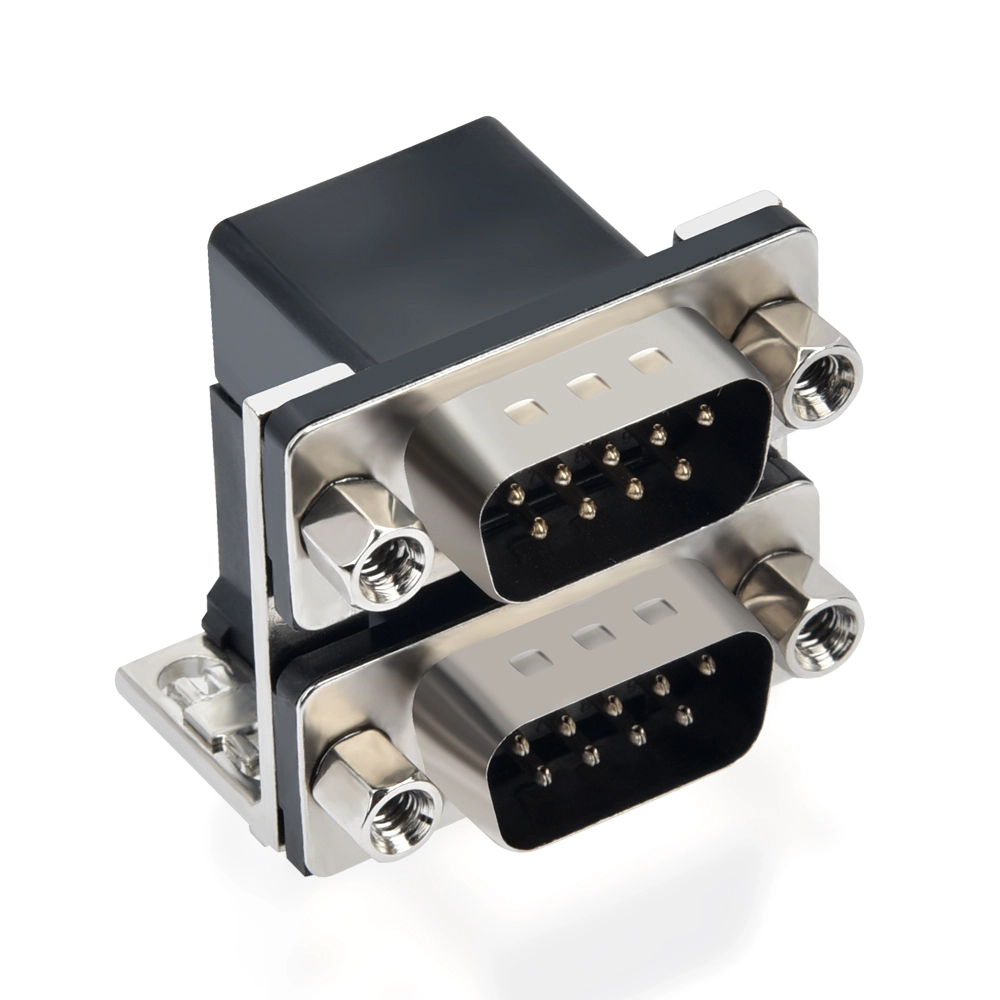
9-Pin Male to 9-Pin Male Stacked D-Sub Connector ADAMICU
Features

Applications
Expand one COM port from an industrial control computer, PLC or server into two serial ports, each connecting to a different terminal device (such as a touch screen, barcode scanner, or frequency converter).
For the console configuration ports of routers, switches, and firewalls, multiplexing is enabled. Administrators can use one stacked port to connect the main configuration line, while leaving the other port available for on-site maintenance personnel without the need for plugging and unplugging.
Applications of old-fashioned modems and multi-serial port cards.
Industrial automation and control:
Data upload/download and real-time monitoring for CNC machines and robot controllers.
Connecting RS-232/485 configuration ports of central air conditioning controllers, access control systems, DVRs, etc., for debugging and centralized monitoring.
Protocol analysis: Serially connect to the communication link, with one path directly connected to ensure normal operation of the equipment, and the other path connected to a protocol analyzer or serial port monitoring software for debugging, packet capture, and fault diagnosis.
For connecting the serial control interfaces of old-fashioned broadcasting equipment, mixing consoles, or video matrices.
Structural and manufacturing characteristics
| Interface standard | Complies with EIA RS-232C standard (most common), also applicable to RS-422/485 | Connector type | D-Subminiature (D-Sub) |
| Pin count | 9 pins | Interface gender | 9 pins |
| Physical structure | Double-layer stacking: Two independent 9-pin D-Sub male ports are vertically stacked and installed in one housing, sharing a panel mounting locking mechanism | Shell material | Zinc alloy die-cast (standard), with chrome or nickel coating |
| Insulator | Glass fiber reinforced PBT (polybutylene terephthalate), resistant to high temperatures and high insulation | Contact/ pins | Phosphor bronze, gold-plated (commonly 15μ″ or above) to ensure good conductivity and corrosion resistance |
| Cable | Usually uses 24-28AWG stranded shielded cable, PVC or PUR outer sheath | Connection method | Straight-through |
| Locking method | Standard D-Sub with screw locking, or with quick locking/release mechanism | Operating temperature | -20°C to +85°C |
| Rated voltage/current | Approximately 250V AC / 1A per contact |